

Michael Saylor
Most people who reject the standard script do it from outside. They fight the system from the margins and get crushed or ignored. Saylor did the opposite.
- Author
- Charlie XDeveloper
- Published
- Reading time
- 9 min

Every generation of wealth has a founding figure, the man who shows the next generation what to do with it. Old money had its builders: the bankers, landowners and industrialists who understood that capital exists to be kept and handed on, not performed. New money has mostly produced the opposite, which is loud, fast and fragile.
Michael Saylor is the exception, and the reason is archetypal rather than financial. He is a figure old money would recognise at once: the steward of a treasury, disciplined, patient and unembarrassed by conviction. And what he guards is the newest asset in the world. That combination is rare, and it is the one we think ambitious young men should study.
| Saylor at a glance | Detail | Source |
|---|---|---|
| Role | Co-founder of MicroStrategy (1989), now executive chairman of Strategy | Cointelegraph |
| Bitcoin treasury strategy | Began in 2020 with a $250 million purchase as a reserve asset | Coingape |
| Strategy's share of corporate Bitcoin | ~762,000 BTC in March 2026, over 60% of the corporate total | Our macro research |
| Keynote | 21 Ways to Wealth, Bitcoin 2025, Las Vegas, May 2025 | Bitcoin Magazine |
The Man Who Stayed Inside the Walls
Most people who reject the standard script do it from outside. They fight the system from the margins and get crushed or ignored. Saylor did the opposite. He is an MIT-trained aerospace engineer, the founder of a publicly listed software company, and a long-standing member of the financial establishment. He didn't break a law. He used corporate finance, debt issuance and treasury rules, the standard instruments of the system, to buy an asset that no institution can confiscate or dilute.
That is the old-money instinct in its purest form. You do not tear down the house. You re-found it on harder ground. Our research report draws a line between defensive wealth, which survives inside a system it no longer trusts, and offensive wealth, which builds a different one. Saylor is rare because he does both at once: he builds the new structure using the old one's own machinery.
The lesson is that the standard rules are optional, and that the proof can come from inside them. You do not have to leave the establishment to stop depending on it.

Four Saylor Archetypes
People sense something in Saylor that a balance sheet does not explain. We think it is that he embodies four very old figures, the ones every culture has used to describe a man who can be trusted with power. In the tradition Carl Jung opened up, and that Robert Moore and Douglas Gillette later popularised in *King, Warrior, Magician, Lover*, the mature form of each figure serves others, while the immature form serves only itself.
The Steward-King
A treasury is the oldest institution of kingship. A king's first duty was never conquest. It was keeping the realm's store through lean years so that his people survived them. The mature sovereign orders and blesses. The immature one hoards or tyrannises.
Saylor presents himself as a steward in that older sense. He talks about storing value for centuries, not quarters, and the last of the 21 principles in his Bitcoin 2025 keynote is generosity: when you succeed, he says, you should spread joy, share security and offer hope (Blocktempo). That is the sovereign's logic. Power is held so that it can be given away well.
The Hermit
The monastic tradition understood something modern culture has forgotten: a vow is a technology for focus. Fewer commitments, kept completely, free an enormous amount of attention. Saylor is widely reported to be unmarried, and a co-founder has said he is involved in little beyond his work (Coingape). He has not made his reasons public, so we will not guess at them. The effect is plain, though. It is a life with very few handles on it: few entanglements, few people or institutions with leverage over his capital or his time.
He pairs that with stoic delivery and traditional dress, and the combination reads as a figure out of another century. That is not an accident of style. It is the Hermit's authority: a man who needs nothing from the room is hard to move.
The Guardian
Michael means "Who is like God?" It is a question, not a boast, and in the old tradition it is the Archangel's challenge to anyone who sets himself up as the final authority. The Archangel is shown with two instruments: a sword to defend, and scales to weigh. Hard money is a weighing. A scale does not negotiate, and it does not care who is standing on it.
Saylor leans into this register himself. He speaks of defending the world from economic darkness, and his name, which sounds like a navigator's, only adds to it. The point for a younger man is not to borrow the grandeur. It is to adopt the posture: defend what is true, and judge value by what holds up, not by what is flattering.
The Fire-Keeper
In the Greek myth, Prometheus carried fire to men. In Rome, the Vestals kept the city's hearth fire, and if it went out the city was in danger. Neither owned the fire. They tended it for everyone else. At Bitcoin 2025, Saylor opened by saying that Satoshi lit a fire in cyberspace, and the speech that followed is organised around the idea of feeding it (Simply Bitcoin; Blockbeats). The holder is not the owner of a flame. He is its keeper, and the test of a keeper is whether the fire is still burning when he hands it on.
New Money Meets Old Money
Old money was never only money. It was an order. Clubs, regiments, guilds, lodges and college tables were places where men were vetted on character and conduct, where a word given was a bond, and where the older men told the younger ones plainly what was expected of them. The wealth was the by-product. The fellowship was the point.
Our research report found wealthy families rebuilding exactly this in private: Annabel's and Oswald's in London, Zero Bond and Casa Cipriani in New York, vetted rooms that substitute for the public square. Those clubs have doormen, committees and a blackball. Someone decides who gets in, and someone can decide you are out.
The Bitcoin order has no door and no committee. Nobody can refuse you admission, and nobody can expel you. The only entrance is conviction, and the only dues are the discipline to hold your own keys and sit through the drawdowns. The rules are enforced by arithmetic, not by a doorman. That is why we call it the ultimate boys' club: the one club in which the standard cannot be bent for a friend, because there is nobody to bend it.
What a club like that offers young men is exactly what they are most short of. A standard, a test, and an elder willing to say plainly what both are. Saylor is the senior member and the public face. Strategy is its great hall: it holds over 60% of all the Bitcoin owned by public companies, per our macro research. The 21 Ways to Wealth keynote is the order's creed, and it is worth an hour of anyone's time.
Watch: Michael Saylor, 21 Ways to Wealth (Bitcoin 2025 keynote)
The old rules of the table
The order also inherits old money's etiquette, and the etiquette is practical.
- Discretion. You do not discuss what you hold. The physical-attack data in our research is the modern reason: CertiK counted 72 verified attacks on crypto holders in 2025, up 75% on the year before. A visible leader makes it easier for ordinary members to stay unseen.
- Succession. A key nobody can find is as lost as a key stolen. Old families wrote wills and trusts for a reason. Members do the equivalent.
- Your word. Self-custody means there is no bank to blame. You are accountable to yourself, and that accountability is the whole character test.
The Teacher's Language
Every order needs a teacher who can pass the knowledge on, and the oldest teaching tool is the parable. Saylor strips out the jargon (keys, block times, hash rates) and replaces it with pictures that anyone can hold in their head.
- The leaking vessel. Fiat currency is a bucket holding your life's energy, and it has holes. He calls inflation a melting ice cube. He puts the leak at 10 to 15 percent a year, a figure well above the consumer-price record, which averages about 3.9% a year since 1971 (BLS CPI via in2013dollars). Even that lower figure has cost the dollar about 88% of its purchasing power.
- The island. Imagine buying a block of Manhattan 250 years ago. If you could own a square meter of a digital Manhattan that can never be copied, expanded or taxed out of existence by a local council, what would you pay for it? The listener stops seeing a volatile tech stock and starts seeing finite property.
- The ark. He frames the financial system as a ship with a compromised hull, and Bitcoin as the lifeboat engineered with mathematical and thermodynamic security. The older version of that story is Noah: the man who builds before the flood, is thought eccentric while the sky is clear, and is proved right when it isn't.
The method works because it controls the framing. Instead of arguing about daily price swings, he moves the conversation to survival and engineering. And it respects the listener. He speaks to a man protecting his savings with the same clarity he brings to a boardroom of institutions.
The Vestments
Every order has a habit. The monk's robe, the knight's heraldry and the regiment's tie all say who you belong to before you say a word, and old money learned long ago that a well-cut suit is the civilian form of the same thing. It is not vanity. It is discipline made visible: respect for the occasion and for the people in the room.
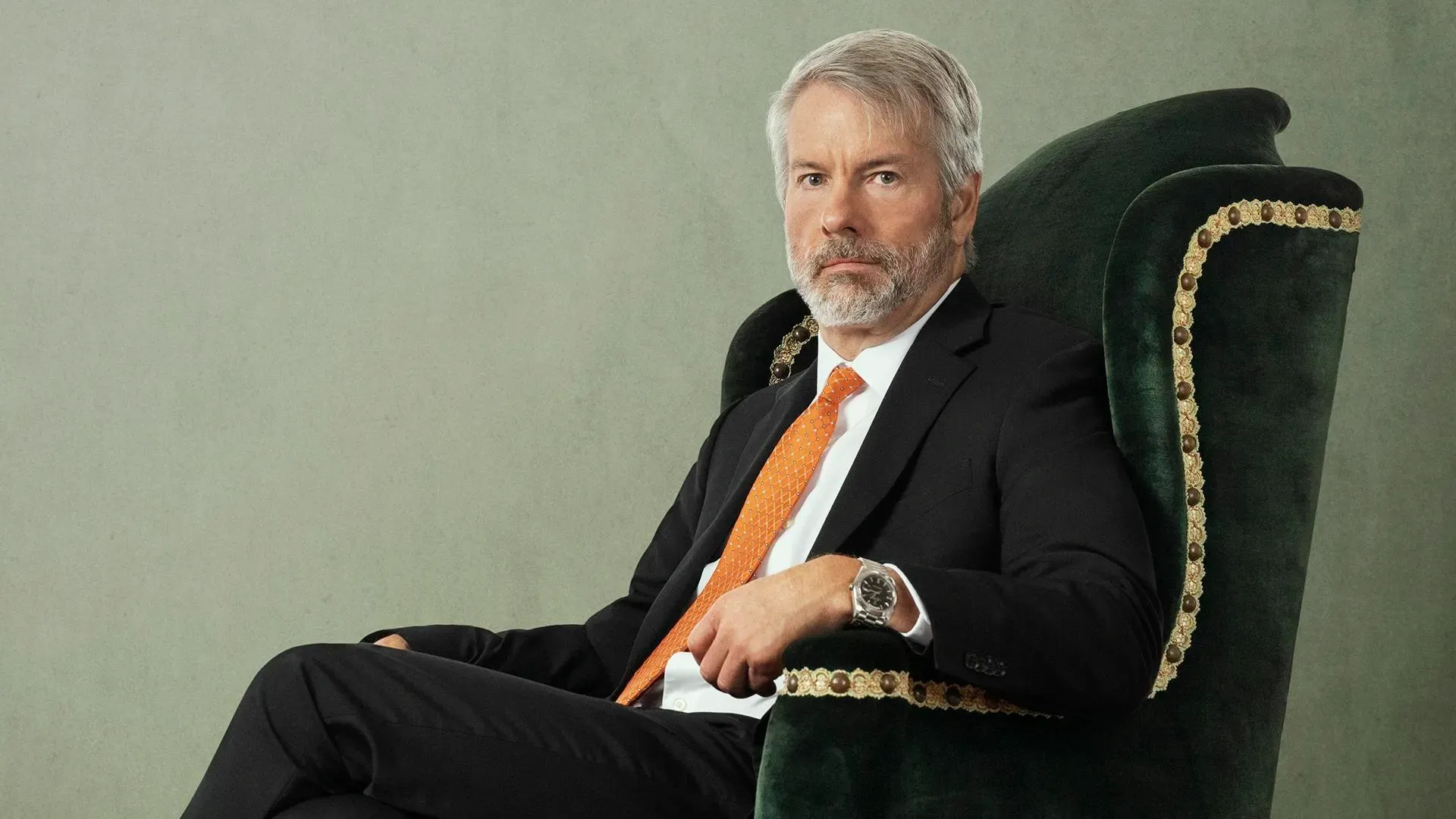
Saylor dresses in immaculate, tailored suits and wears orange, the colour of the Bitcoin logo, as a heraldic device. The cut is traditional and timeless. The colour is the order's. Together they signal a man who is not asking anyone's permission to be taken seriously, and who is committed enough to wear the cause in plain sight.
You do not need to look like a rebel to leave a broken system. You can be well-spoken, well-groomed and entirely professional while holding a worldview that is independent of the mainstream. For young men, that is the useful part of the example. Present like someone who has already decided what he stands for.
Follow Strategies Treasury Template
Words are cheap and balance sheets are not. To see what Saylor's company actually holds, buys and reports, use our Strategy treasury monitor. For the wider argument about why capital is leaving the redistributive state and what it is buying instead, read Be Your Own Bank, Be Your Own State.
Conclusion
The old contract offered protection in exchange for trust, and a growing number of men have concluded that the trust is not being repaid. Saylor shows one answer that does not require rebellion. Be a steward, not a spender. Keep your vows few and your word whole. Defend what is true, tend the fire, dress like you mean it, and join the one order where the standard cannot be bought, bent or revoked.

About the author
Charlie X
Developer
Analyzing sovereignty and the macroeconomic shift toward Bitcoin. Providing high-signal insights designed to protect capital.