
I. Summary: Millionaire Exodus & Wealth Migration Trends
The modern global landscape is witnessing a structural shift in how High-Net-Worth Individuals (HNWIs) and Ultra-High-Net-Worth Individuals (UHNWIs) relate to the traditional nation-state. Wealthy families increasingly treat citizenship, residency, and asset location as flexible tools rather than fixed facts of life.
Historic asset-protection strategies — most famously the geographic diversification practiced by 19th-century banking families — offer an early template for this instinct: don't anchor a family's fortune to the fate of a single jurisdiction. Today's version of that instinct is playing out across tax policy, capital controls, and a growing divergence between high-tax Western states and low-tax, digitally-native wealth hubs. A jurisdiction's regulatory stance on Bitcoin has become one signal — among several — that mobile capital now uses to judge a state's stance on private property and capital mobility.
II. Historical Precedent: The Five Arrows
In the early 19th century, Mayer Amschel Rothschild built a banking network by placing his five sons in five financial centers — London, Paris, Frankfurt, Vienna, and Naples. The often-told lesson attached to this arrangement is the parable of the “Five Arrows”: a single arrow snaps easily, but a bundle does not.
Whatever the merits of the parable, the underlying mechanism was straightforward diversification: by operating across multiple, independent jurisdictions, the House of Rothschild reduced its exposure to any single government's tax regime, war, or default. A loss in one node did not sink the enterprise. That single idea — don't concentrate all capital and all legal exposure in one nation-state — is the throughline connecting 19th-century multi-city banking to 21st-century multi-jurisdiction wealth structuring, including the current interest in Bitcoin as a jurisdiction-agnostic reserve asset.
III. The Debt Crisis of Old Money
As European nations shift toward a wartime fiscal footing and prepare for heightened geopolitical tension with Russia, several governments are leaning on a familiar three-part toolkit under pressure: currency debasement, higher taxes on wealth, and tighter capital controls framed as national security measures.
Sovereign debt markets are showing signs of strain across major economies:
- The Anglo-Saxon Contraction: The UK has seen significant capital flight, with wealthy individuals and families reassessing sterling-denominated holdings amid changes to non-dom status, inheritance tax treatment, and other wealth-tax proposals.
- The European & American Bond Trap: Long-duration U.S. and European sovereign bonds have underperformed as markets price in continued deficit financing and elevated defense spending.
- The Far East Fracture: The Japanese Yen and Japanese Government Bonds have faced structural pressure, while China has seen sustained high-net-worth outflows tied to “Common Prosperity” policy, capital controls, and a soft domestic real estate market.
IV. Exodus: Macro-Migration Data
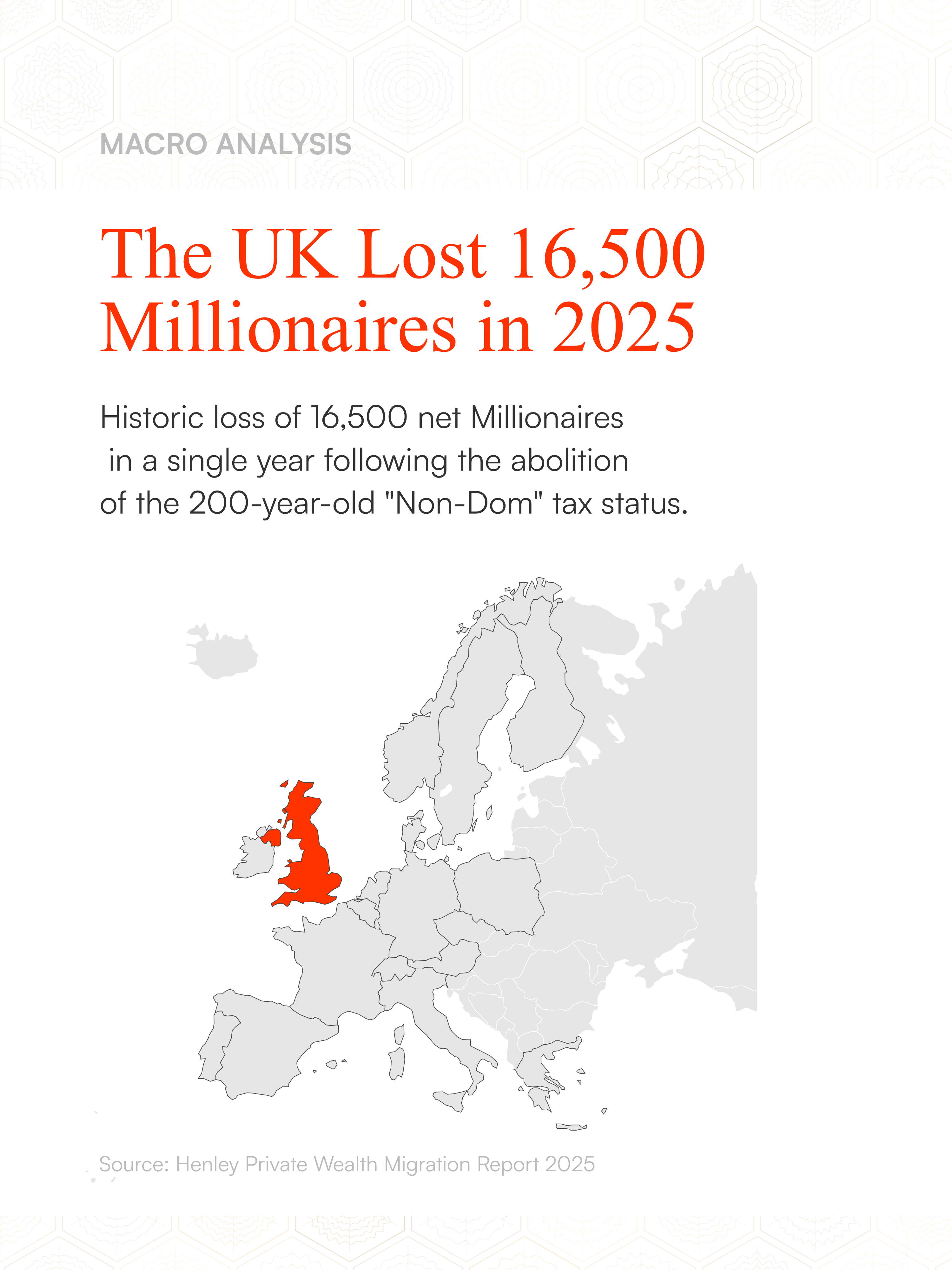
1. The United Kingdom
Forecast Net Outflow (2025)
16,500 millionaires — Henley & Partners, 2025 Wealth Migration Report
Primary Catalysts
Abolition of the 200-year-old “Non-Dom” tax regime (April 2025); integration of foreign trusts into the 40% inheritance tax matrix; proposed wealth-tax measures
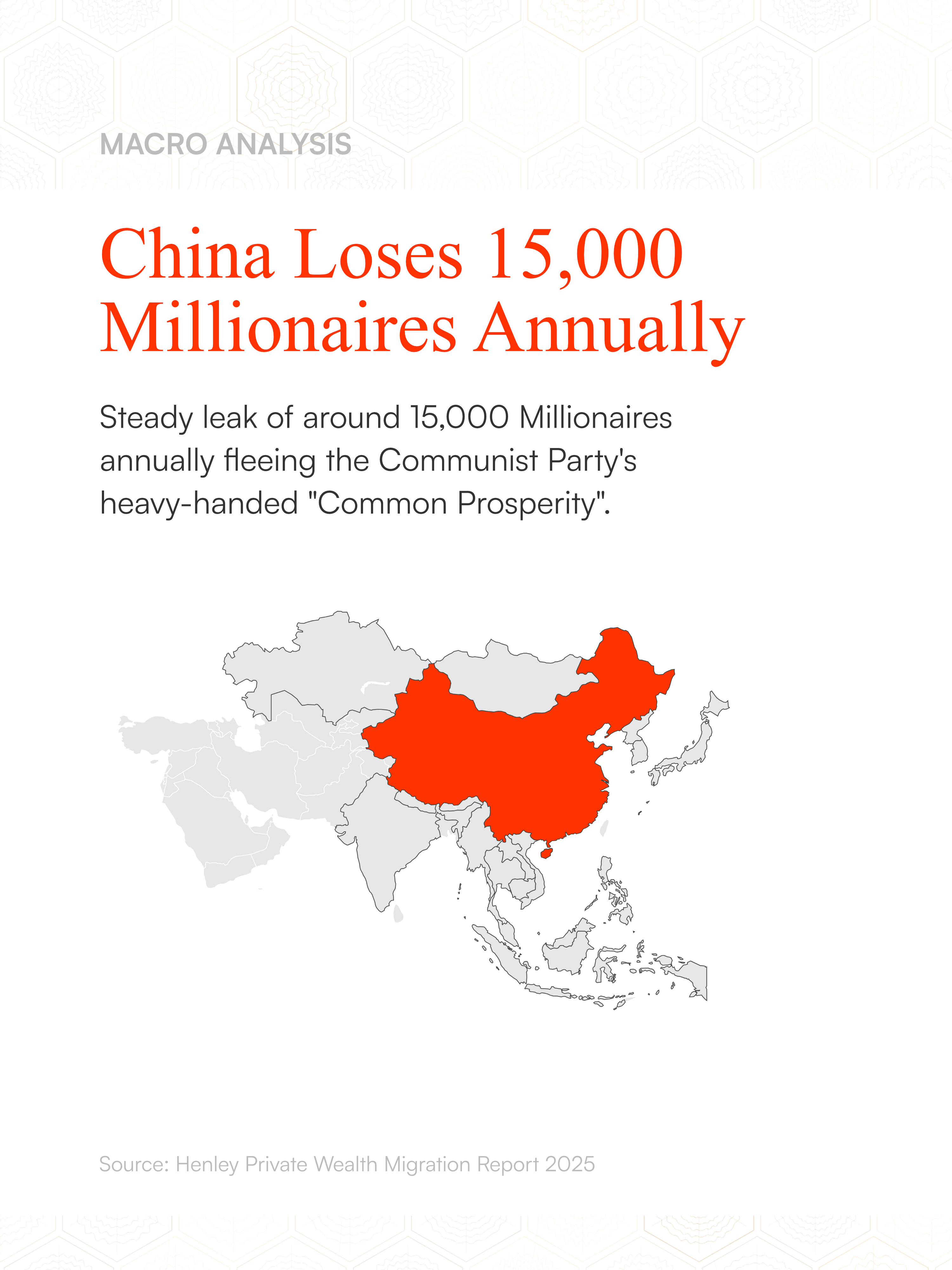
2. China
Net Outflow (Annual Average)
10,000–14,000 millionaires (New World Wealth / industry estimates)
Primary Catalysts
“Common Prosperity” interventions; regulatory pressure on private technology founders; softening domestic real estate equity; outbound capital controls (~$50,000 per citizen)
4. Global Context (UBS Global Wealth Report 2026)
Set against the outflow narratives above, the global millionaire population is still expanding in aggregate: global personal wealth grew 10.8% in 2025, with the millionaire population growing 1.5% — nearly one million new USD millionaires, or roughly 2,680 per day. The U.S. accounted for the largest share of that growth, adding more than 440,000 new millionaires. The picture, in other words, is less “wealth is vanishing” and more “wealth is redistributing across jurisdictions,” with specific high-tax markets (UK, parts of China, New York) losing share to specific low-tax, wealth-friendly ones.
V. The Bitcoin Proxy: Three Global Channels of Capture
A jurisdiction's regulatory posture toward Bitcoin has become a fast-reading signal of its broader stance on capital mobility and private property. Three jurisdictions illustrate distinct models:
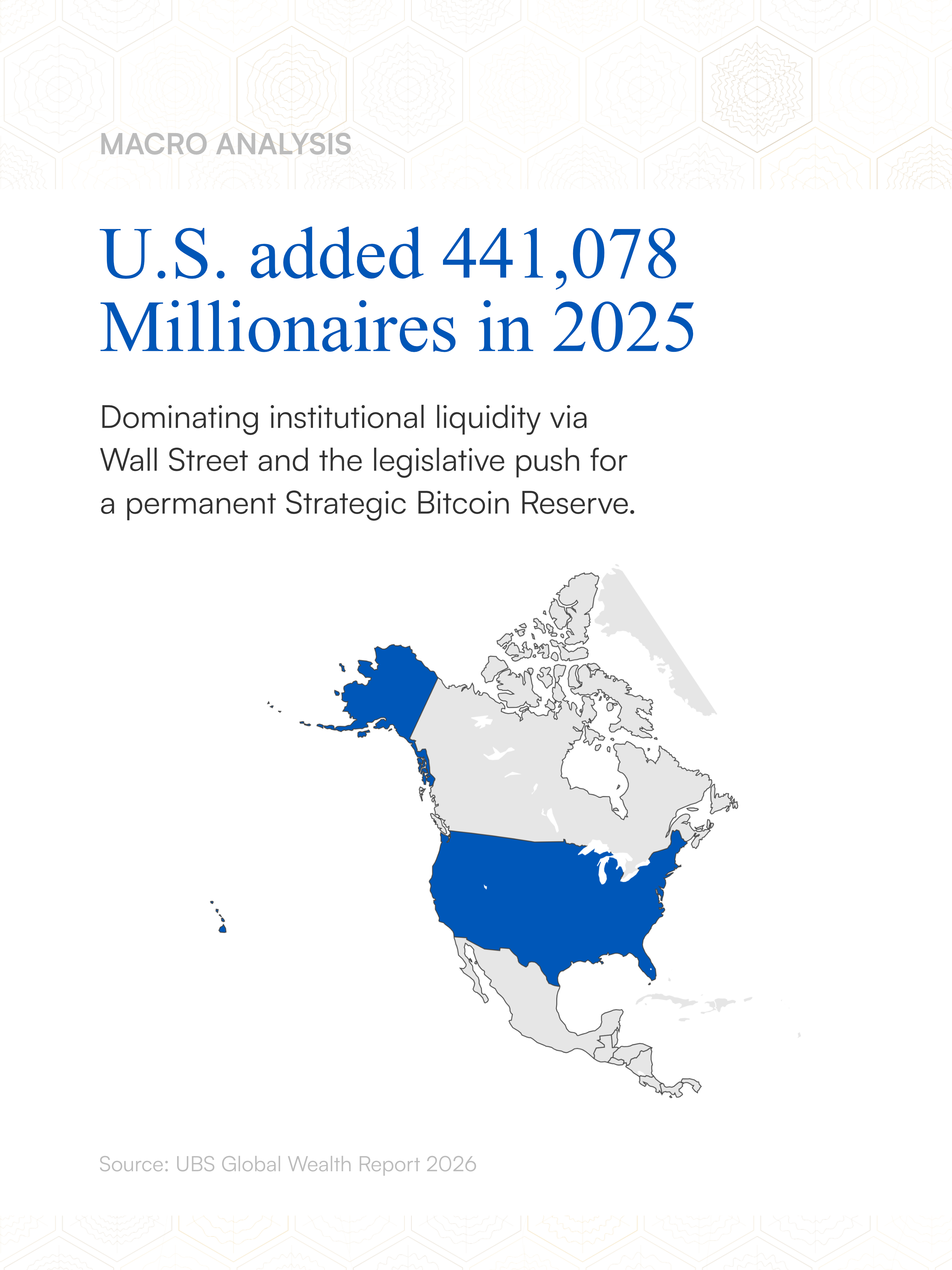
1. United States — The Institutional Epicenter
Regulatory Stance
Institutional capitalization & state reserves
State Holdings
~324,527–328,372 BTC held via federal criminal forfeitures
Strategic Profile
Best suited to institutional funds and publicly traded asset managers needing deep, regulated liquidity; capital gains tax exposure remains high (up to 20% federal + state surcharges)
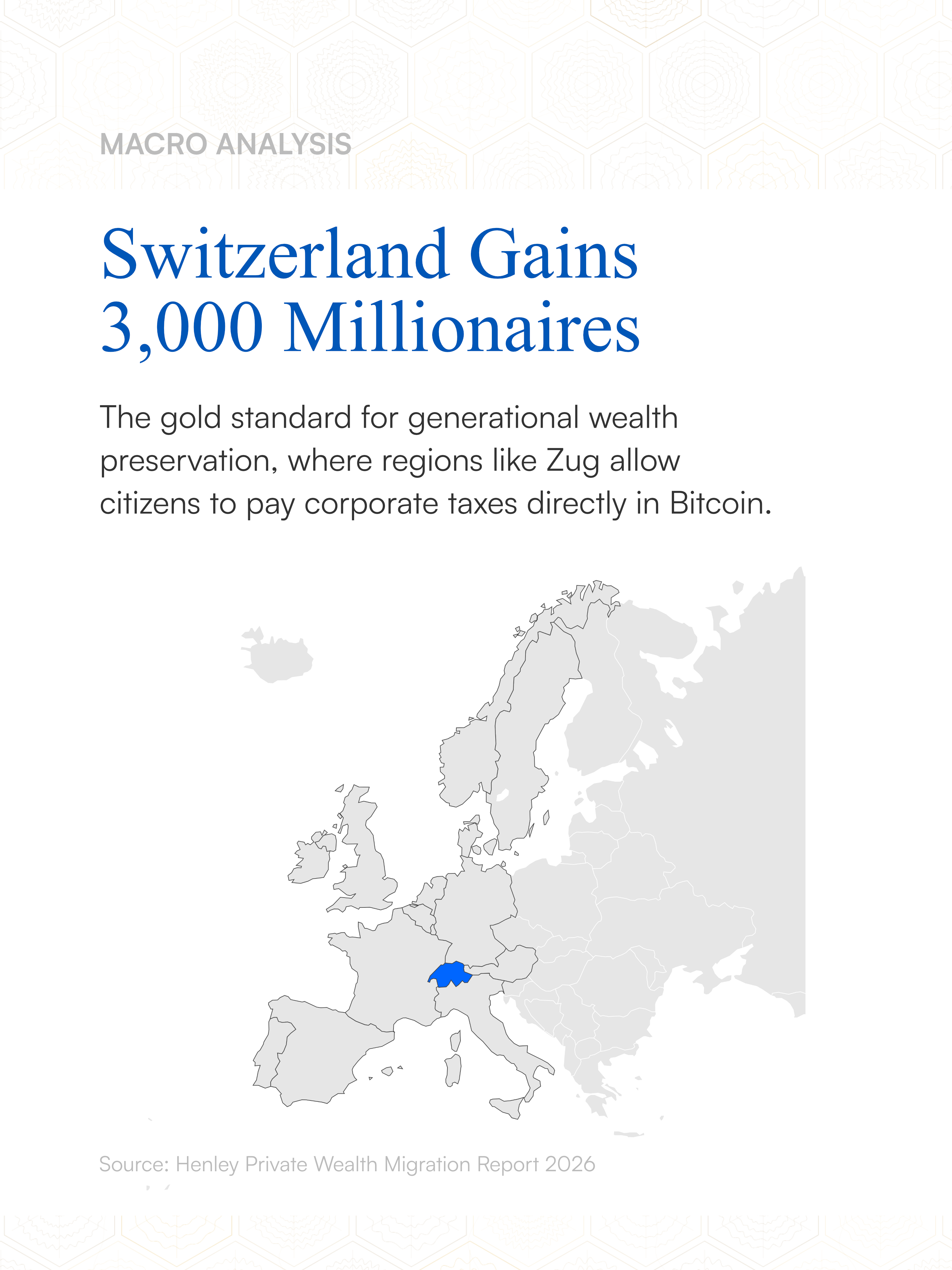
3. Switzerland — The Sovereign Vault
Regulatory Stance
Established private-banking integration
Fiscal Landscape
0% capital gains tax for private, non-professional investors; Zug accepts BTC for municipal tax payments
Infrastructure
FINMA-regulated; private banks (Sygnum, SEBA, Swissquote) offer native multi-signature custody alongside CHF fiat rails
Strategic Profile
Preferred base for family offices and longer-horizon wealth preservation structures
VI. Conclusion
The throughline across both the historical record and the current data is diversification, not doom. Wealthy families have long reduced single-jurisdiction risk by spreading assets, residency, and now digital holdings across multiple, independent legal systems. The current wave of migration out of high-tax markets like the UK and China, and into low-tax hubs like the UAE and Switzerland, follows that same logic — with Bitcoin functioning as one more jurisdiction-agnostic asset class in an increasingly multi-jurisdictional playbook.